- Published on

Star Carr, 45x36, ©lesliepetersonsapp

A carr is a British term for a swamp. I had to look it up.
What Is the Mesolithic Era?
Not helpful? How 'bout this?
It is a period of time between the Ice Age and the Agricultural Revolution. So, it’s the time between when people were nomadic and when people started to farm in permanent settlements. During the Mesolithic, people were what would be called semi-nomadic, with sites they would return to cyclically as the seasons revolved and resources presented themselves.
This era occurs at different times in different parts of Eurasia.
In the Middle East, it’s roughly 15,000- 8,000 BCE.
In Europe it’s 10,000- 5,000 BCE.

Reconstruction of a Mesolithic house ©David Hawgood


What Makes Star Carr So Special?
1. People were on the move, so they didn’t have a lot of stuff.
2. Much of what they made was from organic material. Think bone, willow branches, hides, wood, reeds. Think of a marshy environment and what resources that would provide.
3. Northern Europe is wet, and a lot of the soil is acidic. So, much of what these people left behind has rotted away.
Artifacts and remains are well preserved in either dry environments (think of all those mummies in Egypt) OR in low-oxygen environments… like deep in the mud of a marsh. Or peat.
Life on the Lake

Reconstruction of the western platform ©Marcus Abbott
This is so they could access the deeper water of the lake more easily.
Year after year, when the logs settled into the lake bed, they would add more logs on top.
But this platform was not only used for lake access. It was clearly a place for ritual as well.

Composite photograph of brushwood from Clark’s 1951 excavations ©David Lamplough

The Waters Edge
Everywhere around the world, there is evidence of people ritually depositing objects into bodies of water, like pennies into a wishing well.


Star Carr Archaeology Project sc15video70

My Process with Star Carr
Although I have displayed diptychs and triptychs before, the vertical format is new territory.
Also, the two panels are of dramatically different sizes: the upper is 36x36, the lower 9x36.
In this panel, you can see the semi-submerged log platform, the shining moon above, and an ethereal red deer regarding us by the waters edge.
I imagine the large, hovering frontlet as maybe the spirit of the red deer, with whatever magic was attributed to it, gazing at us, watching over us, maybe threatening us, we just don't know.


As is often the case, I felt compelled to use a ruler and create a geometric underpinning, or underlying lines.
(This is one of the eccentric compulsions I have, that I am lately embracing, rather than attempting to diminish!)


In contrast to the upper panel, where I imagine what the creators of the frontlets may have experienced, I want the lower panel to show our current relationship to the site, and the wonder of finding the remnants of the people living there. The lower panel is below the upper one to represent how we find these vestiges underground, in the Earth.


Star Carr, Lower Panel, 9x36 ©lesliepetersonsapp


Image: Grahame Clark at the 1951 excavation. ©Scarborough Archaeological and Historical Society
Next, I used a composite photograph of his discovery of the log platform. I am impressed by how difficult it must have been to take these images. Now we just send up a drone. Back then they had to build platforms above, and a very skilled photographer would clamber up, lie on their stomach, and shoot each picture. Later it was stitched together to create this.

Composite photograph of brushwood from Clark’s 1951 excavations ©David Lamplough


©Star Carr Project, CC BY-NC 4.0

In doing the research for my piece, I became fascinated by the MANY MANY "plans", or schema of the log platforms produced by the Star Carr Archeology Project.
Here I must thank Dr. Harry Robson, who took time out from what I am sure is a very busy schedule to help me attain permission to use these images. (And by the way- he found THREE frontlets at Star Carr!)


Star Carr, Detail, Lower Panel, 9x36 ©lesliepetersonsapp

I seek to express the tension between our imaginings of times past, and our scientific knowledge of it.
To hold as one these seemingly opposite stances makes our understanding more rich and meaningful.
Resources and Cool Links
I'd like to thank Dr. Harry K. Robson, Postdoctoral Research Associate at The University of York for his assistance with this blog entry, and for helping me to understand image permissions for the artwork.
Star Carr has a wonderful website devoted to it, The Star Carr Archeology Project.
Finds from Star Carr can now be seen in four museums: The British Museum, the Yorkshire Museum, the University Museum of Archaeology and Anthropology at Cambridge and the Scarborough Museum.
- Published on
My journey into the caves.

Bison sculpture, 15,000 BCE
I and 10 other people, some artists, some not, gathered in the Dordogne Valley, France.
The Dordogne Valley has one of the highest concentrations of Paleolithic art in the world.
But we didn’t just go visit the caves. We then took time to process what we experienced together using art, movement, and dream exploration.
The Caves
I realize that I am an artist who blogs, not a travel blogger, so I will simply tell you which caves I visited, then talk about the impact they had on me.
By the way- photography is not allowed inside the caves, so I am showing images I have pulled off websites devoted to the caves.

Aurochs Paintings in Lascaux IV

Me at the Lascaux interactive museum.
Below are the four real caves I got to see.


I also got to see Cap Blanc, which is an “abri,” or rock shelter that has relief carvings. They were probably also painted, but the pigment has been worn away over time.

Cap Blanc

A Profound Experience

Pech Merle hand print, 18,000 BCE

Then, suddenly, you see the outline of a human hand, created by a person holding their hand up to the rock, and blowing liquid pigment, leaving a negative hand-print.
Imagine you knew the person who made that print has been dead for 20,000 years. And here you are, looking at it. It looks fresh and new, like the person pressed their hand to that rock the day before.
For me, it was an extraordinary, almost mystical experience.
The Artmaking
First, I created two small paintings on paper, using stencils, little sponge rollers, watercolor pencils, collage, and something called a gelli plate, which is a way to make monotypes.


The Essence of Art
I struggle with making art I describe as "performative," by which I mean, result-oriented. I can easily slide into the territory of doing something for the sake of approval.
So, there’s a tension, because on the one hand, I want to do artwork that’s good quality and appeals to people. But on the other hand, I want to make art that purely authentic and comes from my heart.
Going into those caves and seeing work from artists/shamans from tens of thousands of years ago really brought me into direct connection with the fundamental drive humans have to dream, to communicate, to create and express ourselves. It reminds me that this is my primary missive, sales and accolades be damned.

Lascaux, ca. 15,000 BCE

The images I saw in those caves were so elegant and sophisticated, yet so simple. Even the “incomplete” drawings had a completeness to them.
I’m a better drawer than I am a painter. I have always felt as though presenting "just drawings" was never acceptable, and that I had to gussy them up with a bunch of paint.

A drawing I did of an Etruscan tomb painting

This trip was a profound experience, and I feel very different. My hope is that this difference will continue to grow in my heart and mind, and that it will inform my artmaking from this time forward.


- Published on
In this new piece, I am combining images from two famous archeological finds, The Cup of Nestor, and an image from The Tomb of the Diver.

©lesliepetersonsapp The Cup of Nestor 12x12 Mixed Media

The Cup of Nestor

The Cup of Nestor
What is an alphabet?

Totally cool pic of Cuneiform
Writing systems had been around for a long time before that. Around the Mediterranean, it started with pictograms, then moved onto hieroglyphs, then to actual scripts, such as Linear A, Linear B and Cuneiform. But the symbols used in these systems signified entire concepts, words, and then syllables.
This meant that it could be used to write down poetry, names, anything you like.
Writing systems were used mostly for accounting and keeping track of trade. How many bushels of wheat, how many amphorae of oil, where did it go and how much money did it yield? Only very particular professionals used writing, and they used it for some very dry, but essential transactions. No one else used writing. Why would they? It was boring.

Numerical tablet, 3500-3350 BC
Along came the Greek alphabet.
Exactly how, where and when it was invented is pretty foggy. But what is clear is that it was developed from a writing system used by the Phoenicians, a sea-faring cluster of peoples living along the coast of today’s Lebanon and Syria. Someone took this writing system and developed it so that the sounds of words could be captured.
It took off like a house on fire. Elite men across the Greek world with its far-reaching colonies and cities started to write. Writing became cool.
It became all the rage.
One of the world’s first recorded jokes.
It’s an inside joke about old King Nestor in the Iliad. It reads: “I am the cup of Nestor, a joy to drink from. Whoever drinks this cup empty, straightaway the desire of beautiful-crowned Aphrodite will seize.”

The actual inscription on The Cup of Nestor

Today, “symposium” tends to indicate a gathering where elevated ideas are shared, perhaps featuring an enlightening debate or lecture series.

Boring Symposium

Fun Greek Symposium

A symposium in classical Greece did have erudite discussions, music and poetry, but it was also a ribald party where everyone got soused.
The Tomb of the Diver


The inscription on the Cup of Nestor is not specific about who the object of desire would be, once the cup was drained.
It may even imply the desire it induced might be indiscriminate.

- Published on

Distracted Mind, Artistic Mind

Just like Little Red Riding Hood, my mind is not good at staying on the path. It wanders off and picks flowers, attracted by the next, and the next, and the next more captivating bloom.
I’ve got a terrible memory. I often forget essential aspects of whatever task I am performing. (Recently I set off to buy new glasses, leaving my prescription at home.)
I was trying to develop some sort of regular, consistent, doable habit in regards to posting on social media about my art. “Everyone” was buzzing about social media.
- You should post everyday so you can be in good with the “algorithm.”
- Reels are the next big thing. Everyone is doing reels.
- Stories are the thing. You’ve got to do stories.
- First you post, then you share it all over the other “platforms.”
- Every "platform" has specific demands, like on Twitter you can have only four pictures, but Instagram you can have ten. Stories videos are only 15 seconds long, but Reels are 90.
And so on, and so on. All that resulted from this was a panicky sense of dread.
Enter, the Mind Map


Here is all is. I spent hours on this silly thing.
I tried to impress my friends by sharing it with them, but they didn’t even want to LOOK at it, and who could blame them? It seems overly elaborate and faintly ridiculous now, but the one most important thing is also true: now I know.
Now I know. Social media is no longer confusing to me. I may need a reminder of the specifics, but the tiny scraps of paper have settled down into an orderly pattern. Now I understand.
I became filled with the desire to understand these little scraps in context, in an order, like maybe a mind map… or maybe… a time-line.
Enter, the Time-line

I decided on a very general form: seven areas of the planet, drawn with seven horizontal lines. The time demarcations will be the vertical axis. But, I am still not sure what time periods I am going to depict, and where they will land. So, I started to write bits of information I find intriguing on bits of rice paper, and started to tape them up at various places. Everything at this point is in flux and movable.
I feel like a mad scientist.
Enter, the Mad Scientist

Scene from A Beautiful Mind, 2001
My beautiful, inefficient, scattered, forgetful, creative, artistic mind.
- Published on

I have two magazine subscriptions (Archaeological Institute of America, and Current World Archeology) and look forward to them like a kid waiting for his Captain Midnight Secret Decoder Ring to arrive in the mail.
I find myself so fascinated by archeology that, at some point, I may create an entirely new body of work. It's all very speculative, but it is very exciting for me, and I wanted to share it with you now.

My first endeavor was a pencil sketch of the remains in burial Mound 17.


But the thing that makes it all the more more fascinating, is that there is actually no body there at all. The acidic soil of the area consumes organic material.


But, like the "sand men", the actual ship, chamber, and body have long since dissolved. But the wood of the ships hull, again, changed the make up of the sand, and what was left was a ghostly impression of a ship, along with the corroded iron rivets, in long, graceful, curving lines.
This is a photograph of Basil Brown, standing in the middle of the ship. He was the self-taught archeologist who excavated the un-looted grave in 1938.
The second image here is a schematic drawing archeologists have made, depicting what they believe the original burial chamber within the ship contained.


The third image here is a schematic map of the area, with black dots depicting the location of various burial mounds, and the three hypothetical routes by which the mourners transported the ship from the River Deben, up the bank, to the burial site, to inter the deceased.
I will continue with my current series of art based on film noir until it feels right to commence on this new path.
Maybe I never will get to it, or maybe I will start next week.
Stay tuned.
- Published on

I'm on vacation, and I'm having a wonderful time. It's a paradise. Beautiful room, white sand beach, gorgeous view.
And yet, I find myself having a difficult time relaxing entirely. I'm relaxing, but not completely relaxed. I find that I am suffering from a case of the "Shoulds".
Here are a list of my "Shoulds":
- I really need to take advantage of my time here!
- I should make a drawing or painting everyday.
- I should keep posting and staying engaged on social media.
- I should NOT post, and disengage completely.
- I should go I to a deep state of contemplation so I can start developing concepts and imagery for my next body of work.
- I should start collecting words and images for my next body of work.
- I should do paintings of the coastline so I can include coastal scenes in my next body of work.
- Furthermore, I should barely eat anything, so I will still feel okay in my bathing suit.
- I should drink less/more.
- I should swim in the ocean.
- I should go for a hike/sample authentic local cuisine/learn to paddleboard...
Get the idea? So much to ponder and worry about.
I heard a while back that the word "should" can be very toxic. It is a good exercise to replace it with the word "want" and see what happens.

Actually, I have done a number of my "Shoulds", because they seemed like fun at the time.
But what have I done mostly?
Mostly, I have gone on a deep dive into some really nerdy books on archeology.
Yes, archeology is my way to relax.
- I have two magazine subscriptions (World Archeology and The American Institute of Archeology Magazine).
- I am a fan of Patrick Wyman's podcast, Tides of History
- I watch archeology themed shows on TV and YouTube incessantly. (My favorite, which is not exactly about archeology, is Mysteries of the Abandoned on Discovery)
So I'm on a geek-fest, learning about how the Proto-Indo-European language, a theoretical language that became extinct around 2500 BCE, was the root from which most of the languages spoken in the world today evolved from.
What can I say? It's what I want to do.

A bibliography of my vacation:
Three Stones Make a Wall, by Eric H. Cline
The Horse, the Wheel, and Language, by David W. Anthony
Tales of Valhalla, by Martin and Hannah Whittock
Beowulf, translation by Seamus Heaney
The Dig, by John Preston
- Published on
Some of you may remember that I love ancient history, and that I did a series of art based on The Odyssey. It was sensational to be in and around the place where The Iliad and The Odyssey was conceived, sung, shared, and eventually written down. In fact, we visited the ancient site of Mycenae, which was the palace complex where Agamemnon himself lived and ruled.

|
| The "Funerary Mask of Agamemnon" from Mycenae, housed at The Archeological Museum in Athens. |
Being in Greece lent depth and richness to my understanding of The Odyssey. One experience I had was the realization that my conception of the space and atmosphere was generalized and lacking in sensitivity. It was fanciful, but vague.
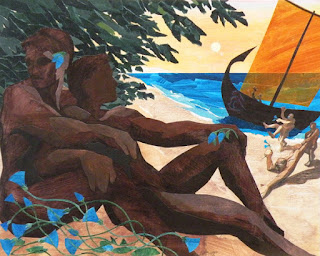
|
| "The Land of the Lotus Eaters" Leslie Peterson Sapp |

|
| Delphi, Greece |

|
| Greece, somewhere between Epidavros and Poros |

|
| "The Shepherd's Song" Puvis de Chavannes, 1891 |

|
| "Patriotism" Puvis de Chavannes, 1893 |
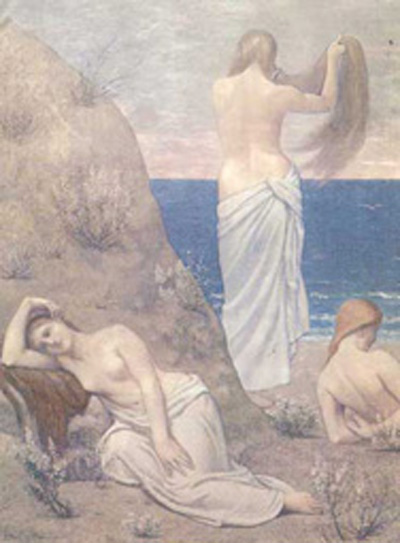
|
| "Young Girls by the Sea", Puvis de Chavannes, 1879 |
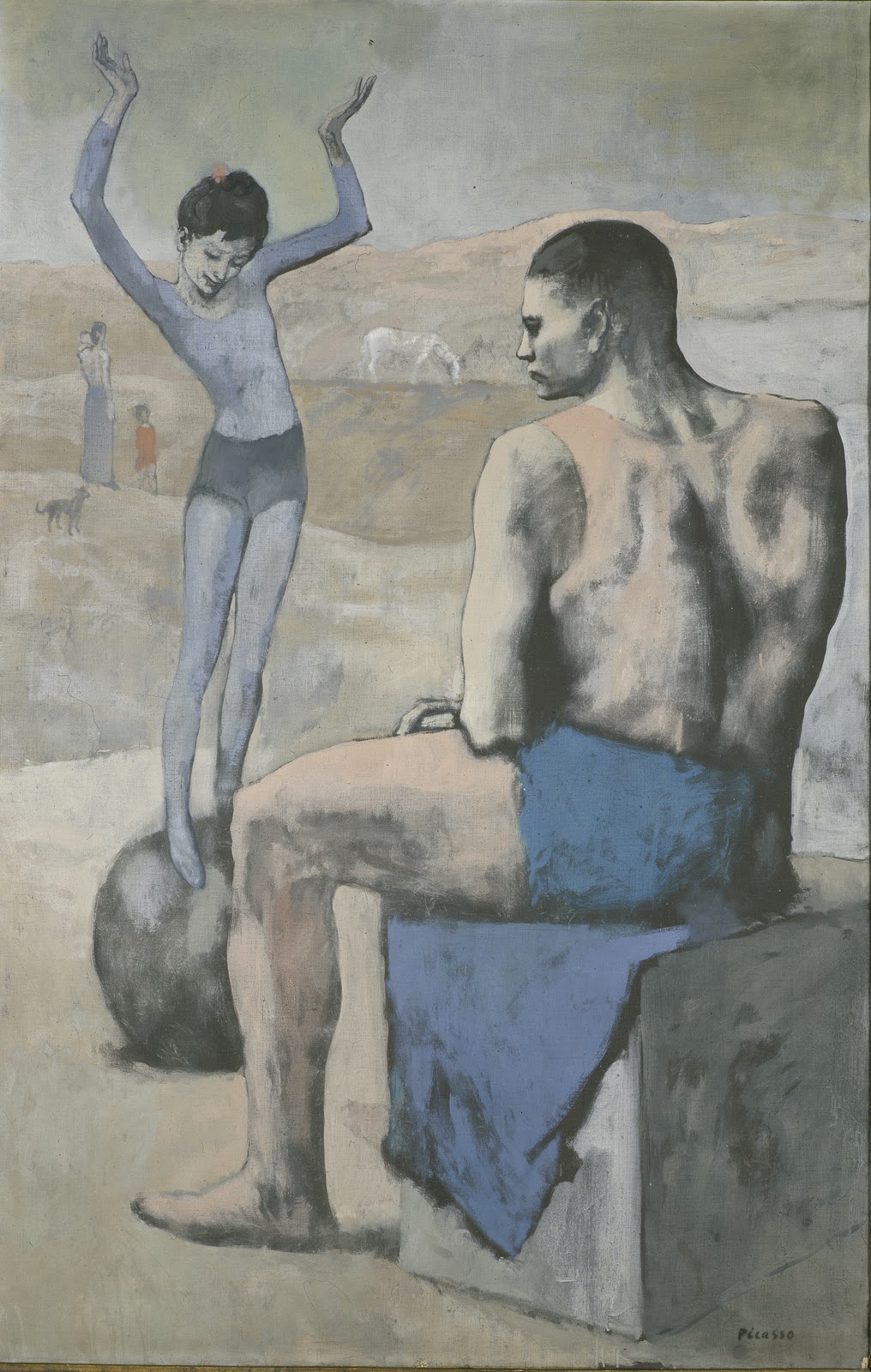
|
| "Acrobat on a Ball" Picasso, 1901 |
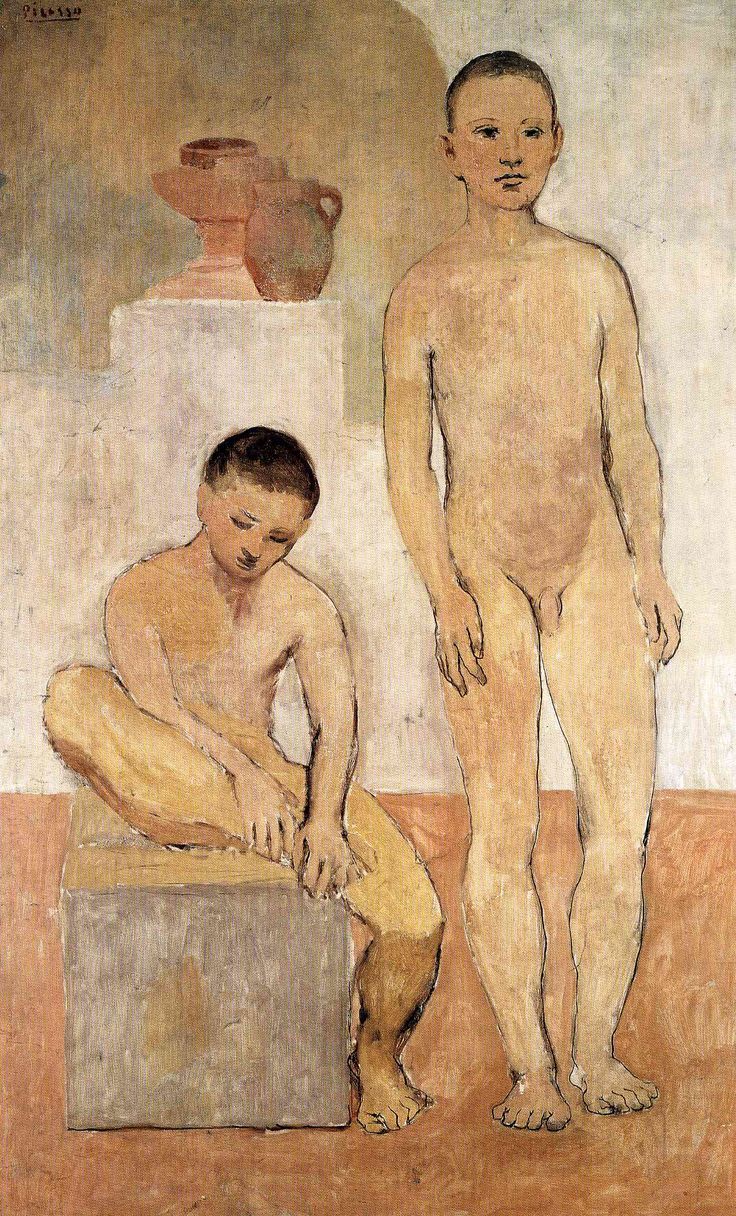
|
| "Two Adolescents", Picasso, 1906 |

|
| "Boy Leading a Horse", Picasso, 1905-6 |
