- Published on
A series on how film noir inspires my art- Entry #6

Night and the City
Placing that call (or hitting "send").
That second drink.
Saying yes (or no).
A scheme. A move. A journey. A purchase.
How many times have our worser impulses lead us into misadventure?
We watch the drama unfold, unable to look away.

©lesliepetersonsapp Backlight 38x48
The strive to win against all odds is often what motivates Antihero- or the giving up is what fuels his self-destruction.

A fatal attraction to the “bad boy” is the plight of many an otherwise prudent woman. Many are compelled to “fix” or heal a wounded man.
The bad boy seems like a shiny, bright apple on the tree of life, just out of reach. Women tell themselves, “If only I could reach him, hold him, heal him. Then he would be mine.”
In the real world, such men are exasperating at best- dangerous at worst.
Yet, the figure of the bad boy, the homme fatale is as romantic as they come.
There is a type of strength that we associate with the quiet suffering we associate with masculinity. The lonely man, isolated and aloof has great dramatic and sexual appeal.

©lesliepetersonsapp Look Out 30x24

©lesliepetersonsapp The Boxer 30x40
- Published on
A series on how film noir inspires my art- Entry #5
First, let us examine the word Femme. Merriam-Webster:
Femme:
1. an adult female person
2. a lesbian who is notably or stereotypically feminine in appearance and manner
Its French, you know? It comes from the French word for woman.
Next, let us examine the word Fatale.
Another French word. It means "fatal”.
Merriam-Webster:

©lesliepetersonsapp Queen of Diamonds 30x20
1. a. causing death
b. bringing ruin
c. causing failure
2. a. determining one's fate
b. of or relating to fate
c. resembling fate in proceeding according to a fixed sequence
Femme Fatale:
1. a seductive woman who lures men into dangerous or compromising situations
2. a woman who attracts men by an aura of charm and mystery
The Femme Fatale is like a fairy tale princess turned on its head. She is the anti-princess. Her nemesis.


The word “nemesis” is often used to refer to an arch enemy or polar opposite, or, as my friend Merriam-Webster sez, “a formidable and usually victorious rival or opponent”.
Astrologically, nemesis is a theoretical star that may have once been a twin star of our sun. A Femme Fatale is a mysterious dark star, a nemesis to the bright, sunny fairy tale princess of my childhood.

Barbara Stanwyck in Double Indemnity

Gloria Grahame in The Big Heat
It has taken most of my adult life to build up some understanding of how to be an entrepreneur, which is essentially what a professional artist is.
I’ve had a lot of catching up to do.

©lesliepetersonsapp Blue Room 40x40
A fabulous article: In Defense of Villainesses, by Sarah Gailey- so much fun!
- Published on
A series on how film noir inspires my art- Entry #4
Modern Art, and design in the Modernist period dealt with this specifically.

Italian travel poster, Mario Puppo, 1948

Italian travel poster, Mario Puppo, 1941

Blind Minotaur Led through the Night by Girl with Fluttering Dove, Picasso, 1935

The Little Fish, Max Beckmann, 1933

Charles Sheeler, Canyons, 1951

©lesliepetersonsapp Glass Houses 30x28
- Published on
A series on how film noir inspires my art- Entry #3
It sought to express emotion and subjective experience by using symbolism, exaggeration, and distortion. In painting, the elements of design were used to support a narrative.

"M" 1931 Fritz Lang

"The Cabinet of Dr. Caligari" 1920
Because the noir aesthetic is so specific, I am obliged to narrow my focus and deepen my decisions, which has honed my skills.

"Crossfire" 1947

©lesliepetersonsapp Lamplight 40x48

©lesliepetersonsapp Exit 28x18
- Published on
A series on how film noir inspires my art- Entry #2
bé·guin|\ bā-gaⁿ \ noun \ bi-ˈgēn\
Definition of béguin
1. a :infatuation
2. a :a vigorous popular dance of the islands of Saint Lucia and Martinique that somewhat resembles the rumba
Etymology: American French béguine, from French béguin flirtation

I was hooked.

©lesliepetersonsapp Fatale 30x36 Collage on panel
Anticipate was the bridge. This was based on a scene from The Killers, but it was so altered, there would be no way to identify it as coming from that movie.


©lesliepetersonsapp Anticipate 16x20 Collage on panel

Blue Room was the first absolute original. I dressed myself up in costumes and took pictures of myself. From those pictures, I stitched together a scene with multiple figures, creating my own movie, as it were.
©lesliepetersonsapp Blue Room 40x40 Collage on panel


©lesliepetersonsapp Miss Darger II 24x30 Acrylic on panel
Entry #1: Why Noir?
- Published on
A series on how film noir inspires my art- Entry #1

©lesliepetersonsapp Passion in the Suburbs
Since I started with this genre, I have engaged with authors, bloggers and social media groups devoted to the subject. I have found enthusiasts out there who seem to know every detail of every film noir; classic American noir, foreign noir, neo-noir- all the noir.
This level of detail and focus eludes me. My mind just doesn’t work that way.
I am an artist. Artists take input and use it as grist to generate unique output.
I seem compelled to tell a story with my art and create a narrative. For me, the act of telling a story is more important than the trappings of time, place and characters.
It is the essence of film noir that I am after, rather than the specific details. During the jazz age, a composer would write a song, then singers and musicians would perform their own version of it. But the structure of the song remained the same. I seek to take the elements of film noir and create my own, unique rendition.

Peer 48x24 ©lesliepetersonsapp
Film Noir? Qu'est-ce que c'est?
Many of them were made by European émigrés escaping the Nazis. They brought with them a grounding in what is called “German Expressionism”.
The unique and sophisticated aesthetic was not fully appreciated at the time; crime movies ran under the radar and attracted no critical praise. But the superior film making techniques have made them gain popularity over the decades.

The Cabinet of Dr. Caligari, 1920

A Brief Primer on Film Noir Part One: The Formal Visual Elements
A Brief Primer on Film Noir Part Two: Oh, the Drama!

It's founder, the Czar of Noir, Eddie Muller, is also a host on TCM's Noir Alley, which shows films noir every Saturday night and Sunday mornings.
- Published on

I have two magazine subscriptions (Archaeological Institute of America, and Current World Archeology) and look forward to them like a kid waiting for his Captain Midnight Secret Decoder Ring to arrive in the mail.
I find myself so fascinated by archeology that, at some point, I may create an entirely new body of work. It's all very speculative, but it is very exciting for me, and I wanted to share it with you now.

My first endeavor was a pencil sketch of the remains in burial Mound 17.


But the thing that makes it all the more more fascinating, is that there is actually no body there at all. The acidic soil of the area consumes organic material.


But, like the "sand men", the actual ship, chamber, and body have long since dissolved. But the wood of the ships hull, again, changed the make up of the sand, and what was left was a ghostly impression of a ship, along with the corroded iron rivets, in long, graceful, curving lines.
This is a photograph of Basil Brown, standing in the middle of the ship. He was the self-taught archeologist who excavated the un-looted grave in 1938.
The second image here is a schematic drawing archeologists have made, depicting what they believe the original burial chamber within the ship contained.


The third image here is a schematic map of the area, with black dots depicting the location of various burial mounds, and the three hypothetical routes by which the mourners transported the ship from the River Deben, up the bank, to the burial site, to inter the deceased.
I will continue with my current series of art based on film noir until it feels right to commence on this new path.
Maybe I never will get to it, or maybe I will start next week.
Stay tuned.
- Published on

I'm on vacation, and I'm having a wonderful time. It's a paradise. Beautiful room, white sand beach, gorgeous view.
And yet, I find myself having a difficult time relaxing entirely. I'm relaxing, but not completely relaxed. I find that I am suffering from a case of the "Shoulds".
Here are a list of my "Shoulds":
- I really need to take advantage of my time here!
- I should make a drawing or painting everyday.
- I should keep posting and staying engaged on social media.
- I should NOT post, and disengage completely.
- I should go I to a deep state of contemplation so I can start developing concepts and imagery for my next body of work.
- I should start collecting words and images for my next body of work.
- I should do paintings of the coastline so I can include coastal scenes in my next body of work.
- Furthermore, I should barely eat anything, so I will still feel okay in my bathing suit.
- I should drink less/more.
- I should swim in the ocean.
- I should go for a hike/sample authentic local cuisine/learn to paddleboard...
Get the idea? So much to ponder and worry about.
I heard a while back that the word "should" can be very toxic. It is a good exercise to replace it with the word "want" and see what happens.

Actually, I have done a number of my "Shoulds", because they seemed like fun at the time.
But what have I done mostly?
Mostly, I have gone on a deep dive into some really nerdy books on archeology.
Yes, archeology is my way to relax.
- I have two magazine subscriptions (World Archeology and The American Institute of Archeology Magazine).
- I am a fan of Patrick Wyman's podcast, Tides of History
- I watch archeology themed shows on TV and YouTube incessantly. (My favorite, which is not exactly about archeology, is Mysteries of the Abandoned on Discovery)
So I'm on a geek-fest, learning about how the Proto-Indo-European language, a theoretical language that became extinct around 2500 BCE, was the root from which most of the languages spoken in the world today evolved from.
What can I say? It's what I want to do.

A bibliography of my vacation:
Three Stones Make a Wall, by Eric H. Cline
The Horse, the Wheel, and Language, by David W. Anthony
Tales of Valhalla, by Martin and Hannah Whittock
Beowulf, translation by Seamus Heaney
The Dig, by John Preston
- Published on
It came from Out of the Past- from 1947, to be exact. This scene from the famous film noir inspired images in my head that I couldn't shake.

So, in April 2021, I took a video of myself in costume walking down the stairs. Then I created a large drawing from that video. From that I developed a painting... But, like many worthwhile endeavors in life, there were twists, turns, and backtracks along the way.
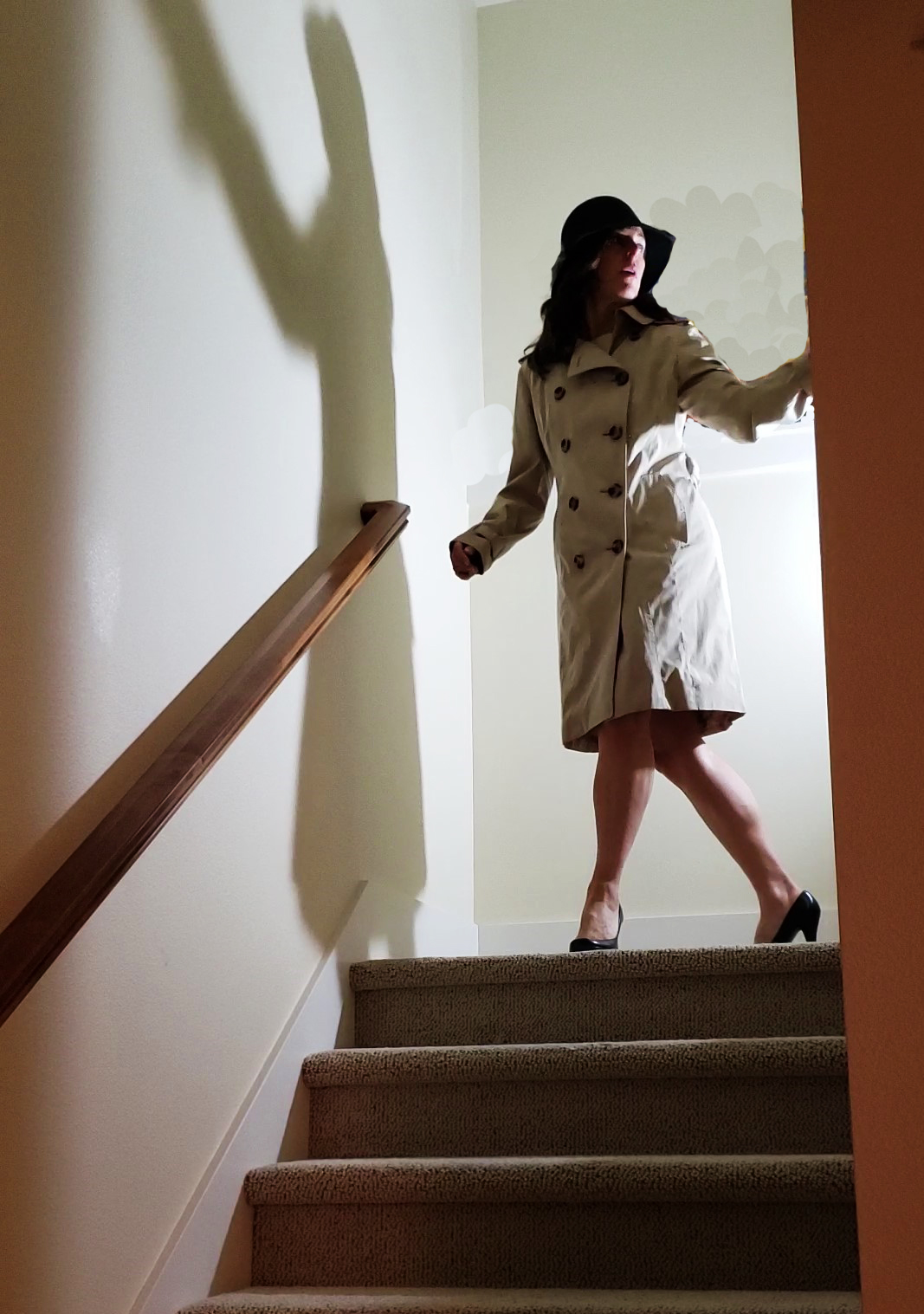
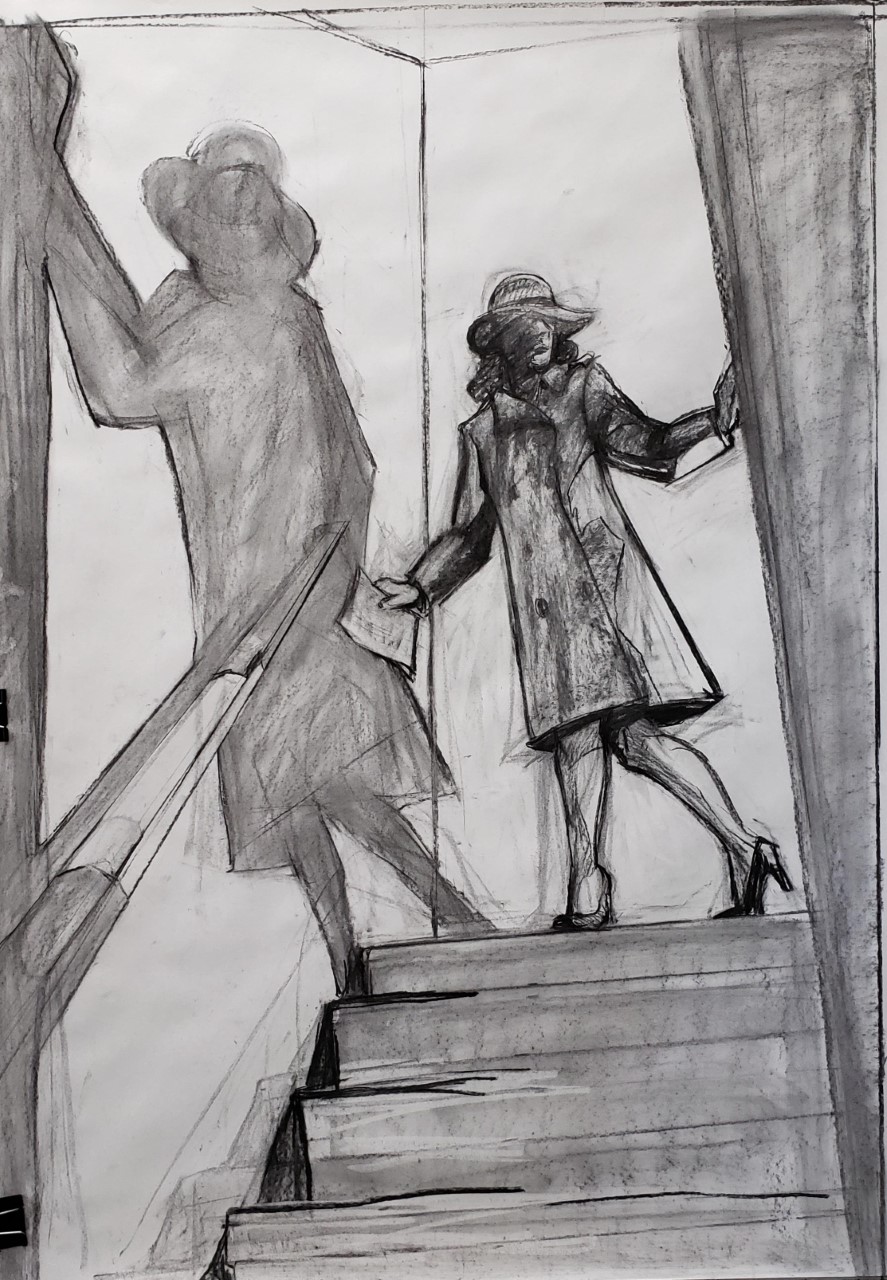
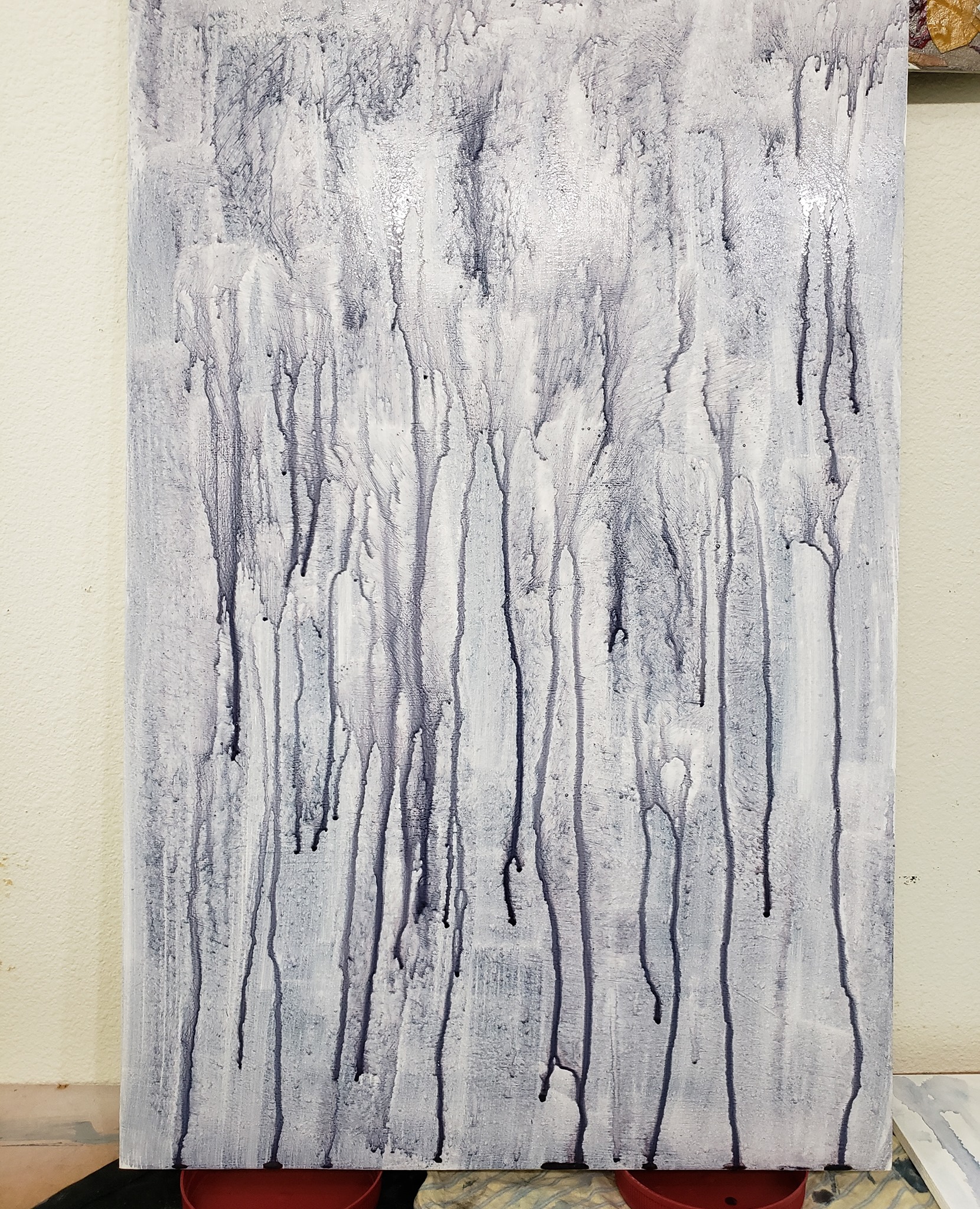
I love working off of colored, textured grounds. So, in early May, I got off to an interesting start by using purple watercolor and allowing it to drip down the panel.

I sized the image of the drawing in photoshop, printed it out on sheets of paper, and transferred a light image of it onto a panel. Then, using the drawing and the photographs as a reference, I started the painting.
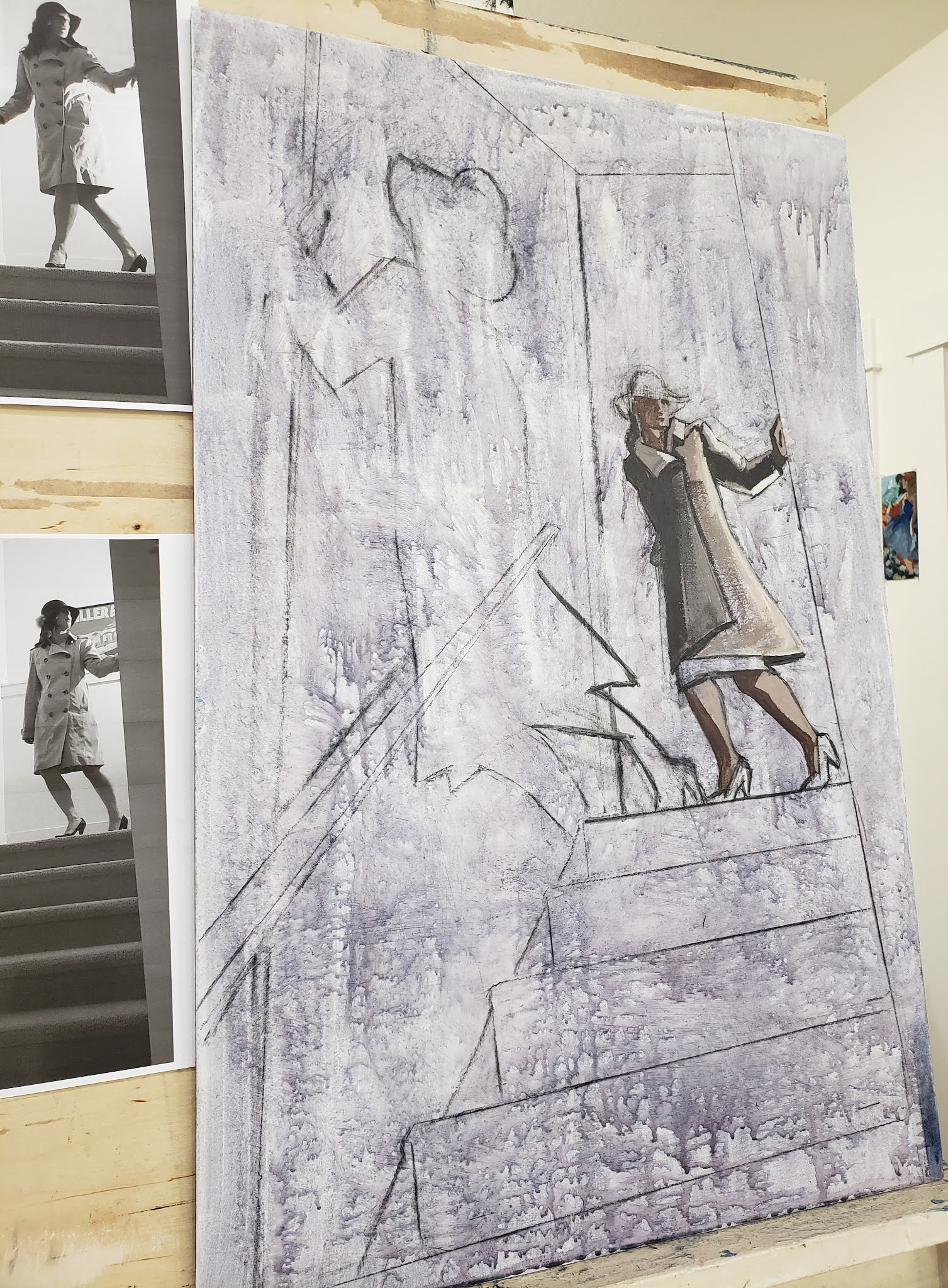
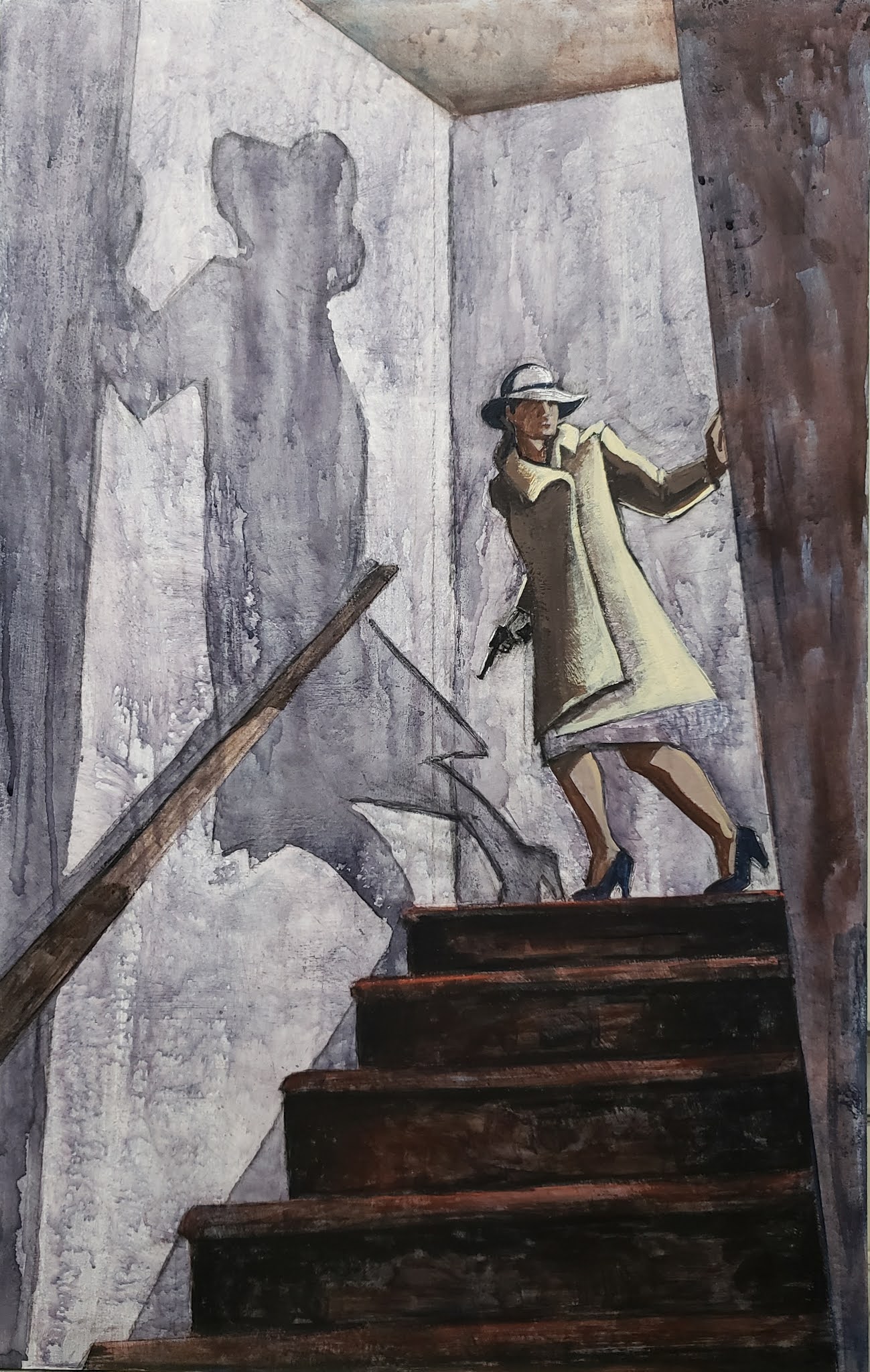


I also "closed up" the space, by making sure all walls, stairs and shadows were touching each other, enclosing the figure in with no way to "escape".

Break time.
This all happened from early May to late June. I set Exit aside. I worked on other projects, such as The Hanged Man and Watch.


There may have been a beach trip or two as well...
All the while, I kept looking at Exit out of the corner of my eye... June ended... July ran its course...
I kept thinking... this could be better.
It's flat.
It doesn't have the glossy dark depth I had envisioned...
It needs... blue.

Here I am, paintbrush in mouth, glazing a layer of Prussian blue over my painting.
I also repainted the exit sign and made it larger.
I changed her shoes from black to white.
I even painted over the precious wood grain stairs I had worked so hard on.

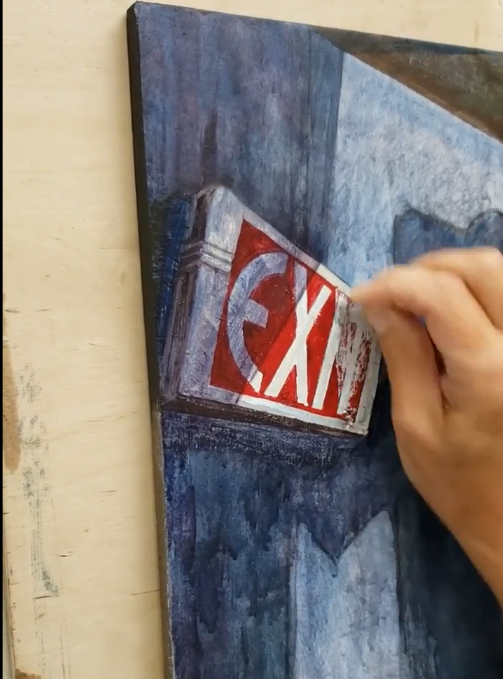

With a tiny scrap of red paper and a bit of tape, I was able to see where to put my lovely vintage exit sign.
As I write this, the exit sign has been redone for a FORTH time-
Will this be my final move? Is the saga of Exit over once and for all???
Finally, finally, I believe it is done. It started in May, and ran off and on until September.

|
| ©lesliepetersonsapp Exit |
We live in a world of expediency, instant gratification and digital wizardry. But along the way, there has been a growing appreciation of the slow. For example, slow foods, artisanal cheese, vintage wine, and hand-made crafts are all important social and financial movements.
By sharing the process of my art, I hope to celebrate the slow and deliberate. Just like life, many artistic pursuits take a long and winding road. Part of what makes art, art, is that the artist takes the time to follow that road wherever it leads.
- Published on
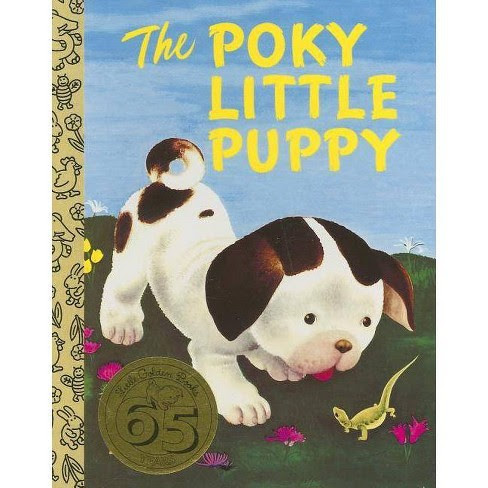
This little book was a staple in my house, as it was in many peoples’ houses. It was a book that was used to gently, or not so gently tease me when I was small.
I was a very poky little puppy.
It was an affectionate and perhaps slightly desperate attempt to get me to look up, to focus, to walk faster, and stop dawdling! The rest of my family seemed to be endlessly charging ahead, onto the next, and the next, and the next activity.

Frustrating, yes, but ADD is closely associated with having a creative mind. No one really knows why. I think it is because all that wandering brings one to unexpected shores and vistas. I heard it once described this way; if one doesn’t think linearly, (marching forward along a path), then one tends to think laterally, that is, back and forth and side to side.
A curious feature in many folks with ADD is called “hyper-focus”. This is when my normally wandering mind suddenly gets into gear, and I become completely engrossed in one activity for long periods of time. This is what happens when I make art.
 I have come to recognize that I am a slow, deliberate artist. Each new attempt takes a long process of conceiving, sketching, drawing, transferring, painting, maybe collaging. When I am “done” with a piece, I will set it aside for weeks, months, and peer at it as it sits in the corner of my studio. I glance at it over the rim of my coffee cup, send it sidelong glances as I work with another piece. Then, often, it hits me. “It needs this…”
I will go back into the painting, and it will transform, like a make-over or a mid-life crisis. It will deepen and mature. Having that time to let it hibernate and incubate will often make a good piece into a great one.
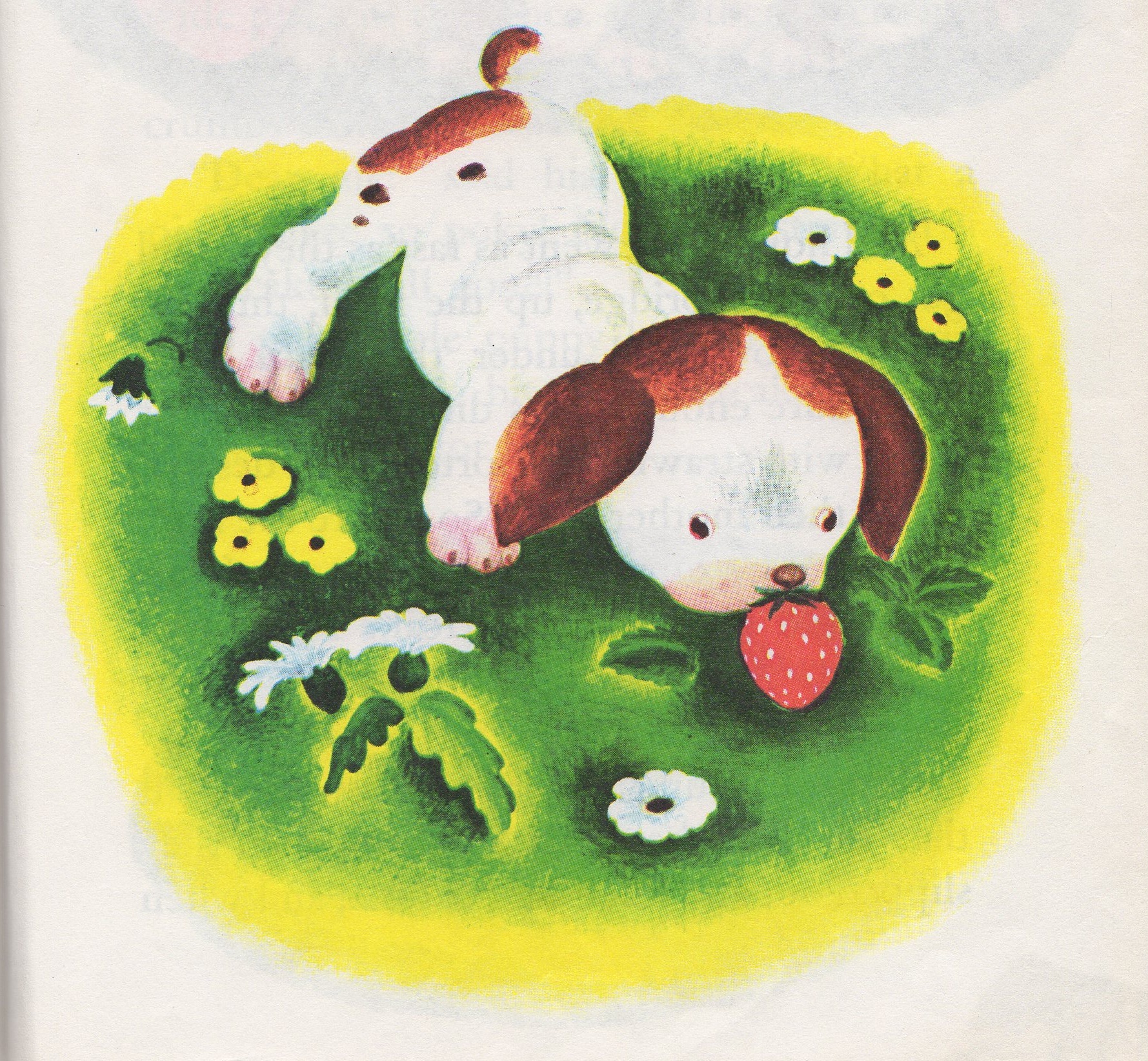
So it goes to show that life isn’t always about the next thing, and the next, and the next. Sometimes we need to stop and smell the strawberries.
One such slow transformation unspooled during the creation of Exit, one of my latest pieces of art. You can read about the creation of this painting here, in The Saga of Exit.